白露
'The Last Laugh': EU Sanctions on Russia Backfiring as Moscow Winning 'Energy War,' Analysts Say_我的网站

一 |
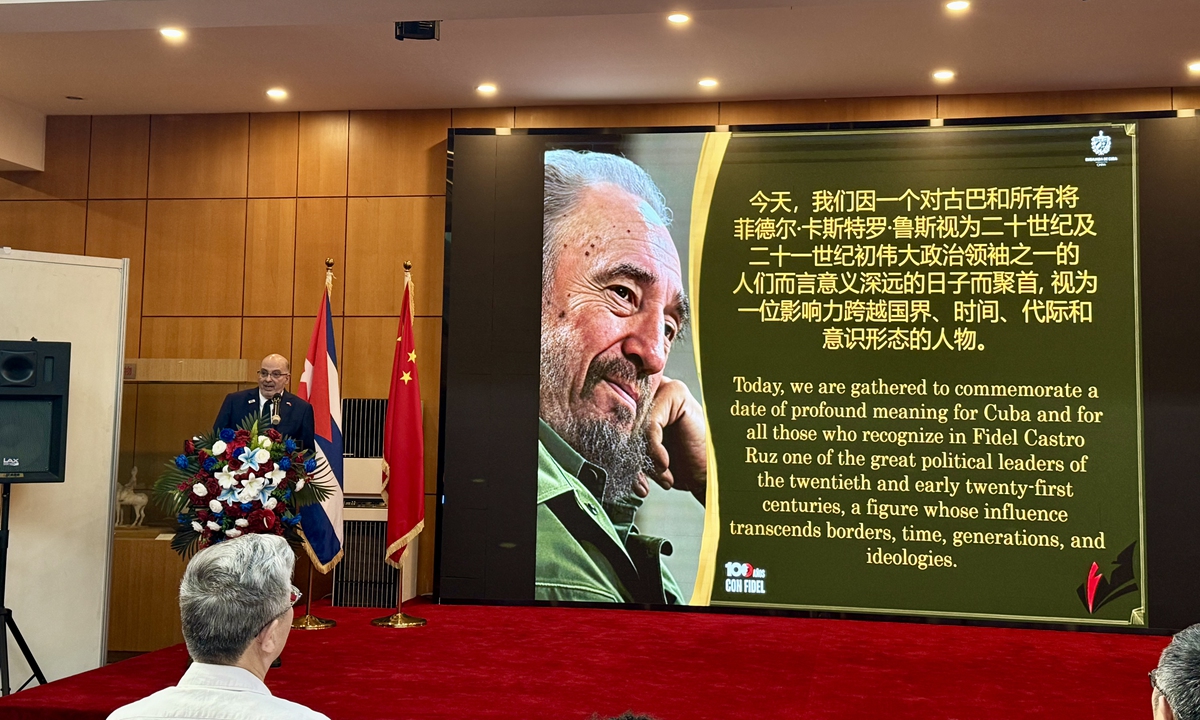
Delegates' speeches evaluated Fidel's role in promoting Cuba-China ties, especially when Cuba became the first Latin American and Caribbean country to establish diplomatic relations with China.
Alberto Blanco Silva, Cuban Ambassador to China, said in his opening remarks that the revolutionary leader is a figure whose influence transcends borders, time, generations, and ideologies.
Blanco noted that Fidel's life was devoted to Cuba's independence, social justice, solidarity among people, Latin American and Caribbean integration, and Global South, the socialist cause, and a more just and equitable international order.
Ambassador Blanco said that from Fidel, "we learned to practice solidarity through deeds, not merely beautiful words; to remain steadfast in the face of adversity and prudent in victory." For decades, Fidel's voice was echoed among developing countries, Blanco said, adding that Fidel promoted transformations that changed the course of Cuba's history.
Blanco also regarded Fidel as a statesman with a universal vision. Recalling the South Summit held in Havana, Cuba, in 2000, Ambassador Blanco quoted Fidel, saying "Globalization is an objective reality, which reveals our conditions as passengers abroad the same vessel - this planet inhabited by us all."
With this metaphor, Fidel illustrated the urgent need to unite global efforts as an international community to save the planet and humanity, preserve the future of our children, and reduce the gap between the North and the South, Blanco continued.
The Cuban Ambassador also noted Fidel's personal attention to China-Cuba relations.
Fidel, on behalf of the historic leadership, took the initiative, during a mass rally on September 2, 1960, to consult the people and announce the sovereign decision to establish diplomatic relations with the Government of the People's Republic of China, making Cuba the first country in the Western Hemisphere to dare take that step, the ambassador said, switching his speech from Spanish to Chinese.
Blanco added that it was Fidel who, with great frankness and courage, addressed the issue of the exclusion of the People's Republic of China and its admission to the United Nations in his speech before the United Nations on September 26, 1960.
Fidel also consistently upheld the one-China principle and, through his speeches and reflections, condemned interference in China's internal affairs and attempts to undermine the territorial integrity and sovereignty of the People's Republic of China. At the same time, Fidel helped foster mutual interest between Latin America and the Caribbean and China.
Moreover, Fidel instructed that the book, The Long March, an account of a great military feat by Red Army in 1930s whose 90th anniversary we are commemorating this year, be published. Fidel knew its history in great detail and regarded it as an inexhaustible source of inspiration, Blanco recalled.
From Blanco's view, Fidel has helped forge a bond that today stands as an example of cooperation between a large country and a small one, based on equality and mutual respect.
The diplomat said that today, the joint construction of a China-Cuba community with a shared future is an expression of the high-level of strategic trust achieved between "our countries and opens new opportunities to expand cooperation for the benefit of both our peoples."
"One hundred years after his birth, Fidel Castro remains present in the memory of all those who are grateful to him and all those who defend just causes, both within and beyond Cuba," Blanco concluded.
One of the reasons why Fidel is still relevant today is that while people commemorate him, they are also reaffirming the value of the bilateral friendship, which Fidel forged and helped strengthen.
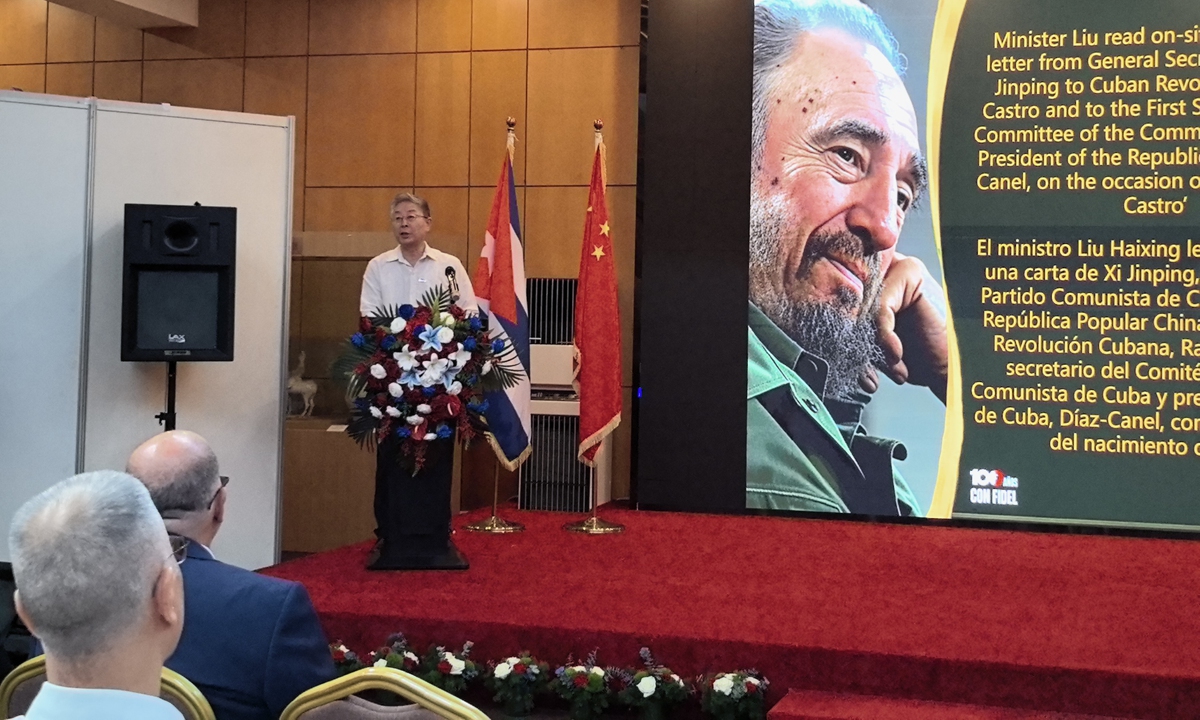
Ma served as Chinese Ambassador to Cuba from 2021 to 2024.
Ma said he visited on numerous occasions the Fidel Castro Center, which is located not far from the Chinese Embassy, as well as museums that feature Fidel.
"The more I learned about Comrade Fidel Castro, the more I was captivated by his noble character, outstanding qualities, and personal charisma," said Ma.
Fidel visited China twice and warmly received several Chinese leaders on their visits to Cuba, making historic contributions to the development of China-Cuba relations. The Chinese people will never forget him, Ma said.
In the current complex and evolving international landscape, China firmly supports Cuba in exploring a path of socialist development suited to its national conditions, firmly supports Cuba in safeguarding national sovereignty and security and opposing foreign interference, and stands ready to work together with Cuba and the wider international community to jointly uphold international fairness and justice, Ma stressed.
。 Western sanctions that followed the launching of Russia’s special operation in Ukraine in February were nakedly aimed at reducing Russia energy exports to zero and making the Russian economy “scream,” as they had similarly attempted with Venezuela and Iran. However, with Moscow securing new markets and prices rebounding, it’s Europeans who are on the losing end of things, experts told Sputnik on Thursday.,According to Bloomberg, prices across Europe are expected to increase sharply later this year, when European sanctions against Russian crude oil exports take effect, with some places predicting a doubling in prices. All this while Russia’s crude oil production and income continue to recover to pre-February levels, thanks to expanded exports to Asian buyers and a healthy relationship with OPEC+.,Western European governments had better hope the winter is warm, because if people start freezing due to fuel shortages, they will demand an end to their government’s policies blocking the gas.,Dr. Mamdouh G. Salameh, a visiting professor of energy economics at the ESCP Business School in London, told Sputnik that “energy is far more formidable weapon in the hand of President Putin than hydrogen bombs.”,“The world, particularly the European Union (EU), is very dependent on Russian oil and gas supplies. That is why Western sanctions have so far largely refrained from sanctioning Russian oil and gas exports to the EU and that is why Russia is winning the energy war,” the economist asserted.,“Western sanctions against Russia have on the whole failed miserably,” he said. “The sanctions are hurting the economies of those imposing them rather than the Russian economy.”,He noted that in the US and EU alike, high gas prices are having widespread effects across their economies, helping to push the EU into a recession.,“There will very soon come the time when European citizens will ask their governments to stop spending billions of dollars supplying Ukraine with weapons rather than use these billions to help them reduce their energy bills,” he predicted. “The day is coming when the EU will reverse course on Ukraine and lift the sanctions against Russia in return for plentiful Russian cheap gas and oil supplies. If it is to be able to do that, the EU has to free itself from the United States’ pressure and stand up to the US.”,“The more sanctions Western countries impose on Russia, the higher the prices of oil and gas surge and the more revenues Russia gets from its energy exports,” Salameh said, adding that “Western analysts and some experts are daydreaming and also deluding themselves if they think that the Russian energy sector is failing. They are trying to talk down Russia’s energy sector but they are doomed to fail miserably.”,“The real irony is that Russia’s economy will emerge in a better shape than most Western economies in the aftermath of the Ukraine conflict. Putin is going to have the last laugh.”,Vladimir Demidov, an international expert on the resources and energy markets, told Sputnik that regardless of the path of European policy, at this point, Russian energy is not coming back. European nations will adapt, but the higher energy costs will stay and will cause Europe’s global standing to decline.,“I don't think there's going to be a global crisis, given that [there is] a fairly rapid filling of underground storage facilities,” he said. “I think that talking about freezing is a fiction, of course, provided that -40 [Celsius] does not hold in Europe. And then, I think, it will be more difficult.”,“Next year, I don't think they will freeze at all,” he predicted. “Enough gas for them and mine, I think they will unpack their coal mines, cuts, quarries. There they will start producing gas at home, by fracturing the reservoir, in general, they will kill nature, but they will have enough gas.”,“And in the future, Gazprom will only supply less. I think its share will fall to 50 billion [cubic meters per day] in the next two or three years, at most. The problem is that everything that is mined by them [Europe] is very expensive. The role of Europe as an economically independent unit of the world economy will simply disappear. Europe will cease to be independent,” Demidov said.,Still, Demidov predicted that Europe’s sanctions policies would continue, even as they set in motion the gradual decline of the continent.,“In Europe, four premiers are gone, including in Great Britain. I do not think that it [governments dissolving] will continue; if the winter is really warm enough, then other premiers will not fly. And everyone is fine, they will say that ‘you see, we did it! These hordes have not conquered us!’ After that, the fall of the European economy will start. The sanctions they have introduced have not been thought through, they will cause themselves more damage than Russia in the next 3-5 years.”。
Current article:http://9rxd.gamajionghuanmuniuzhuanguchu.cyou/550gl5p/zdtri.html
Published on:09:27:00
 守法公民
守法公民 倚天屠龙记吴启华版
 意外
意外 第八号当铺
第八号当铺 文化大观园
文化大观园 谢谢
谢谢 猩球崛起
猩球崛起 赌神
赌神